

The Boat Galley Store
Weather Basics For Boaters: The Details That Matter
Weather Basics For Boaters: The Details That Matter
Impossible de charger la disponibilité du service de retrait
Weather Basics for Boaters: The Details That Matter is a practical, beginner-friendly guide that teaches recreational boaters and cruisers how to read the forecasts and apps they already use, dig past the overview screen, and turn what they see into a confident go or no-go decision. It is not a meteorology course. You will not find pressure gradients or how clouds form. Instead, author Carolyn Shearlock, who has lived aboard and cruised full-time for more than 17 years, shows you which forecast details actually predict comfort and safety on the water, where to find them, and what they mean for your boat, your crew, and your plans.
You checked the forecast. The wind didn't look bad and the radar seemed clear. A few hours later you were pounding into waves, getting tossed around, and wondering what you missed. Almost every boater has that story. The problem usually isn't that the forecast was wrong. It's that the details that decide whether a day is pleasant or miserable were sitting one screen deeper than most of us ever look. This book closes that gap.
You Don't Need to Become a Meteorologist
Great forecasts already exist, built by professionals. What's been missing is clear guidance on how to use them. This book bypasses the atmospheric science and focuses on the real-world skill: reading the apps, websites, radar, and tools you already have, then making smarter calls. You can read it in an evening and start using the method the very next time you head out.
Written in Carolyn's straightforward, no-fluff style, it breaks a complex topic into clear, manageable steps, including how to organize what you find, track changes in the forecast, and make sure you've checked every detail that matters before you cast off.
Read the Details That Actually Predict Your Day
Most boaters glance at wind speed and a wave-height color and head out. The conditions that make a boat slam, roll, or feel like a washing machine are usually hiding in the details right behind that first screen. What sets this book apart is that it doesn't just explain the concepts the way a meteorology text would. It hands you concrete, boater-tested rules of thumb you can apply to a forecast screen in seconds, so you walk away with go/no-go decisions you can actually make, not just theory.
Here's one of those rules, in full, so you can see how the book thinks. For waves, you want the period in seconds to be at least twice the height in feet. If a forecast shows 5-foot waves on a 2-second period, that fails the test badly. It's a recipe for steep, square waves, even though the app screen is still calm, reassuring blue. That single rule will keep you out of more bad days than almost anything else, and it's just one of many the book gives you. A few more examples of how specific it gets:
- Wave period, not just height. Two-foot seas can be a gentle ride or a punishing one depending entirely on the period. Beyond the square-waves rule above, you'll learn to move the pin along your whole route and across the timeline so a window that looks fine at the dock doesn't fall apart mid-passage.
- Gusts over sustained wind. When you decide whether a day is too windy, the gusts matter more than the sustained number. The book includes a quick reference for when gusts cross from uncomfortable into dangerous, and why that line is different for monohulls, catamarans, and powerboats.
- Confused seas. When wind waves and swell come from different directions, the ride gets ugly fast. You'll learn how to read the spread between them and predict the difference between a comfortable passage and a miserable one.
- Wind against current. The classic "the forecast lied to me" situation, especially near inlets and in the Gulf Stream. You'll learn why opposing wind and current stack waves up and how to see it coming in the forecast.
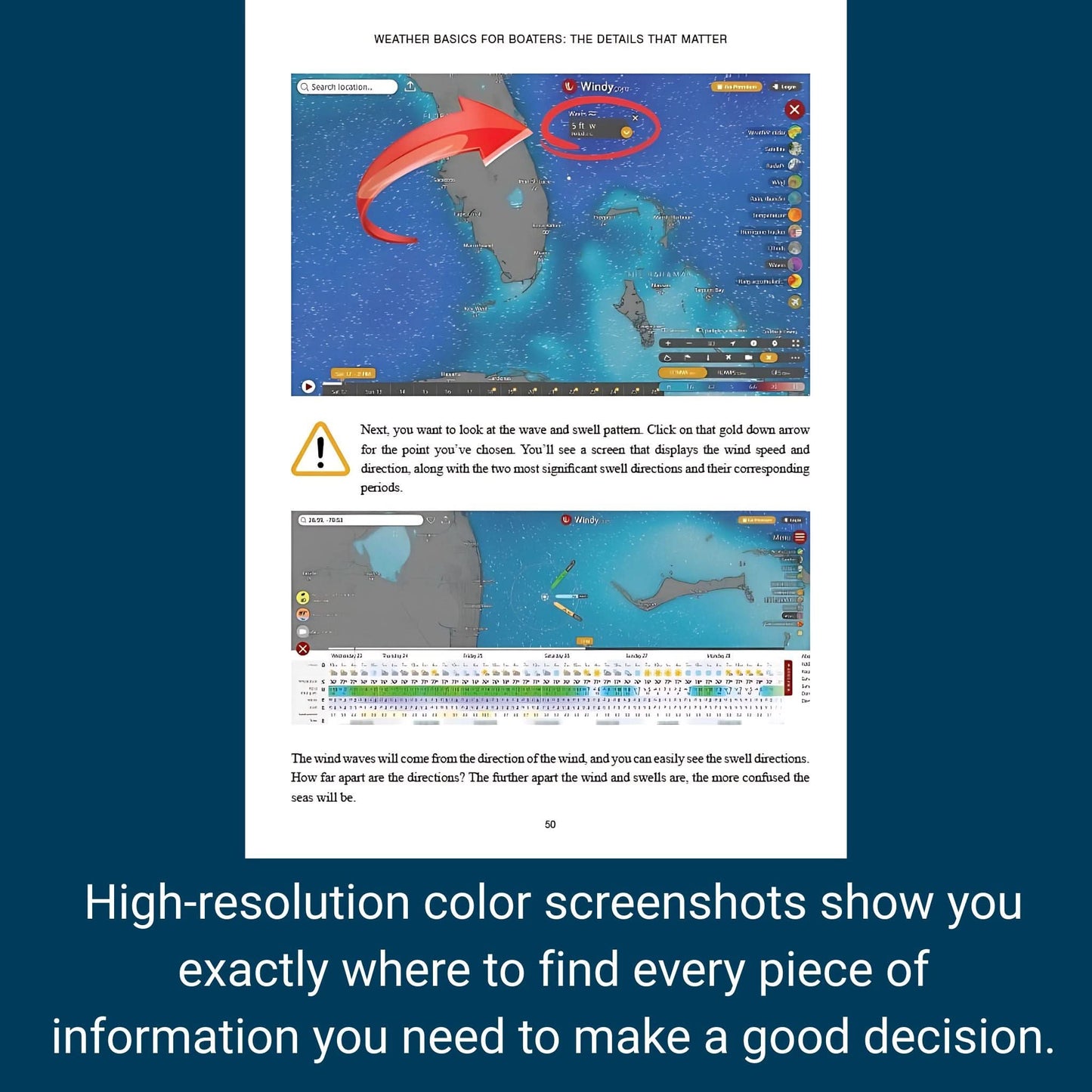
These are just a taste. The book covers far more: wind direction relative to your course, fetch, katabatic and compression-zone winds, squall and thunderstorm risk, the CAPE index, current and VMG, and how to combine model data, radar, and your own eyes with confidence. It walks through where each piece lives in the apps, step by step, with large, full-color screenshots so you know exactly what to look for.
Turn the Forecast Into a Decision
Reading the data is half the skill. Acting on it is the other half. The book gives you a repeatable method for the calls that actually trip boaters up:
- Is it really a weather window? How to define acceptable conditions for you and your crew, review the whole forecast rather than the one favorable part, and pressure-test a window so you don't get fooled by a false one.
- How far can you realistically go? A clear, worked method for estimating your true range in a given window, adjusting for wind, current, bridges, and locks, then building in a safety margin so a trip doesn't turn sour when conditions come in just a little worse than forecast.
- When to wait, turn back, or change plans. How to own the call, resist the outside pressures that cloud judgment, and stay one step ahead when conditions deteriorate.
The method works best when you write things down. Tracking how a forecast changes day to day, comparing today's outlook to yesterday's, is how you tell a solid window from a false one and how you spot the details you'd otherwise overlook. That's why the book includes a free downloadable weather log built for exactly this, so you can put the system to work the same day you start reading. It's included with every format.
Staying Safe at Anchor and Underway
The forecast starts the trip; your attention finishes it. You'll learn how to monitor conditions while underway, including reading the sky and water for the early signs of a building squall, using NOAA Weather Radio and finding the right channel for your zone, and getting the most from your apps and radar once you're moving. There's practical guidance for staying safe and comfortable at anchor, handling squalls when they hit, and knowing what to do when the weather turns worse than expected.
Built Around the Tools You Already Use
This book fits the way boaters actually work. It's built around the apps and sources cruisers rely on, including Windy and PredictWind, NOAA forecasts and weather buoys, VHF weather radio, and professional marine forecasters. It also covers the often-overlooked problem of getting weather data aboard in the first place, comparing cellular, Starlink, and satellite options so you can actually access forecasts where you cruise. It complements the tools in your stack rather than replacing them.
Boating in Hurricane Season
If cruising during hurricane season is part of your plan, you'll learn how to watch the tropics with the Tropical Weather Outlook, how to read the cone map and the text forecast, and why forecast error and forecast continuity mean the cone alone can give you a false sense of security. It's a clear-eyed look at how experienced cruisers assess risk and decide when to start preparing.
- Paperback print: printed on heavyweight paper so the large, full-color screenshots stay crisp and easy to read, with no bleed-through from the other side of the page.
Who It's For
Whether you're brand new to boating and find the weather side overwhelming, or you've got experience but are tired of being surprised by "good" forecasts gone bad, this book gives you the clarity and confidence to plan smarter and enjoy more of your time on the water. It applies to power and sail, coastal day trips and longer passages.
Details
- Author: Carolyn Shearlock, founder of The Boat Galley, 17+ years living aboard and cruising full-time
- Title: Weather Basics for Boaters: The Details That Matter
- Length: 110 pages, large 7" x 10" format with full-color app screenshots
- Edition: Edition 1.1 (2025)
- Formats: paperback print
- Included: free downloadable weather log, with every format
- Focus: Reading marine forecasts and weather apps to make go/no-go decisions, not academic meteorology
- Apps and tools covered: Windy, PredictWind, NOAA forecasts and weather buoys, VHF weather radio, radar, professional forecasters
- Topics: wind and gusts, wave height and period, square and confused seas, wind against current, squalls and thunderstorms, weather windows, trip-distance planning, anchoring, monitoring underway, hurricane season
- Best for: recreational power and sail boaters and cruisers, from beginners to experienced